Bedroom Wallpaper Ideas That Make the Room Feel Finished

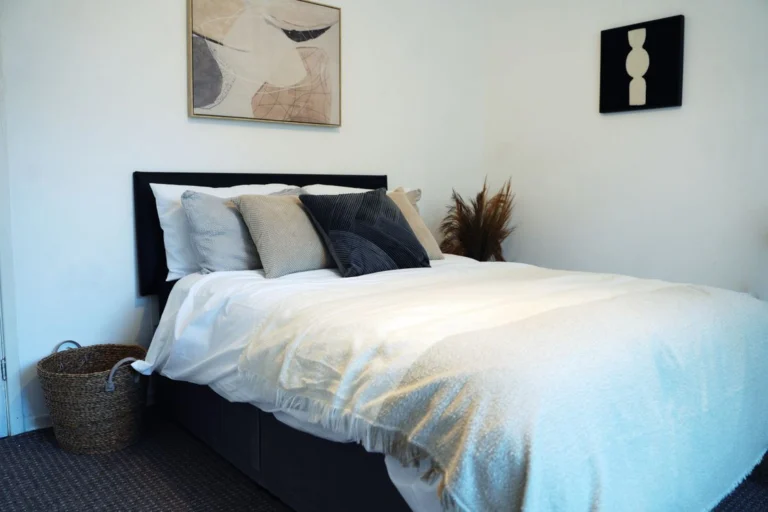
A painted bedroom can be perfectly pleasant and still feel unfinished — flat walls, a bed floating in the middle, nothing for the eye to land on. Wallpaper closes that gap because it does three jobs at once: it gives the bed wall a focal point, adds texture paint cannot match, and ties bedding, curtains and rug into one scheme. The trick is choosing where it goes, how big the pattern should be, and which type you can live with.
Quick Facts
- Standard US double roll: 20.5 in wide × 33 ft long, about 56 sq ft gross, 45–50 sq ft usable after matching
- Safest first move: wallpaper the headboard wall only, paint the other three
- Pattern repeat drives waste — a 24 in repeat can eat 10–15% more paper than a random match
- Peel-and-stick suits renters and one-wall projects; paste-applied non-woven hangs flatter and lasts longer
- Calmest palettes for sleep: muted blues, sage, warm grays, soft whites, low-contrast patterns
- Always order one extra roll from the same dye lot — reorders rarely match
Accent Wall or All Four Walls?
For most bedrooms, the headboard wall is the right place to start: it is the wall you face when you walk in, the bed hides its lower half, and it usually has the fewest doors and windows to cut around. One wall also means one weekend of work.
Go all four walls when the room is large, the pattern is quiet, or the architecture needs help. A small-scale print or a textured grasscloth wrapped around the room reads as a cocoon rather than a statement, and it suits bedrooms where the bed cannot sit centered on a wall — if no single wall is the obvious hero, wrapping the pattern evens things out.
Whichever you choose, do not leave the remaining walls plain builder white by default. Pull a background color out of the paper and match the paint to it, or go one shade deeper. A warm off-white in the family of antique white paint color works with almost any print, because it shares the creamy undertone most wallpaper grounds are printed on.
Match the Pattern Scale to the Room
Pattern scale is where most bedroom wallpaper goes wrong:
- Small room (under 120 sq ft): small to medium repeats — sprigs, pinstripes, tiny geometrics, subtle damasks. A repeat under 12 inches keeps the walls from advancing on the bed.
- Medium room: medium florals, mid-size geometrics and classic stripes — the most forgiving category, and where most bedrooms land.
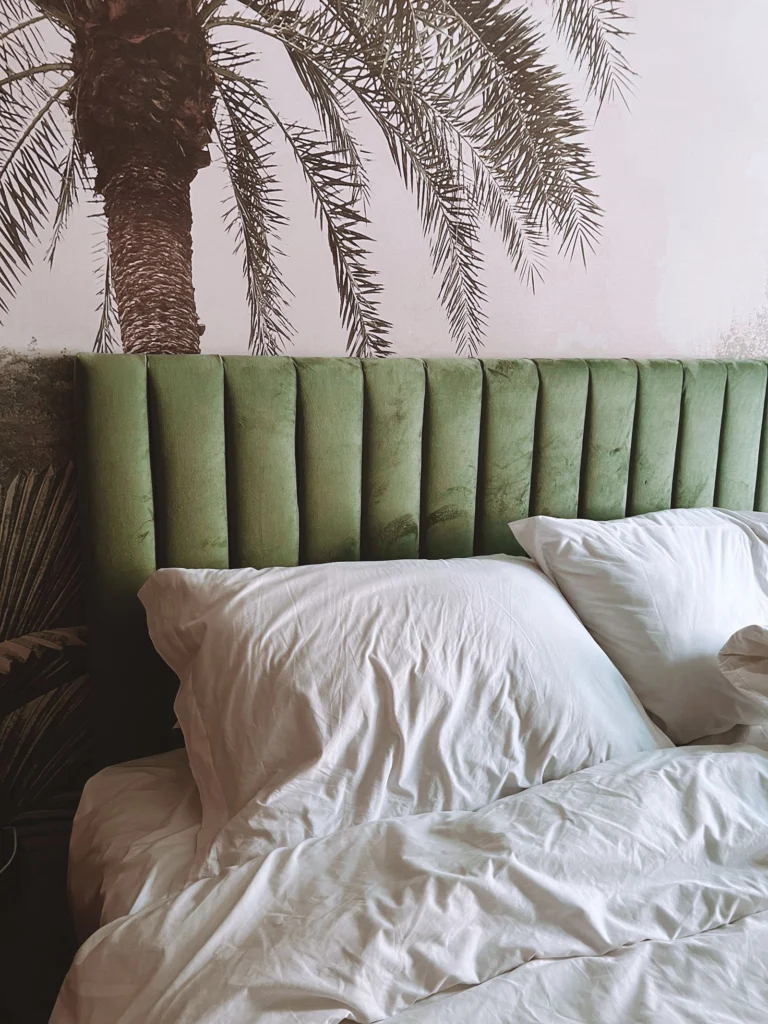
- Large room or high ceilings: large-scale botanicals, oversized florals and murals. Big prints in a big room read as art; the same print in a 10 × 10 can feel like sleeping inside a gift bag.
Ceiling height matters as much as floor area. Vertical stripes add perceived height under an 8 ft ceiling; horizontal patterns do the opposite. If you are working out the furniture for a compact room at the same time, our guide to 10×10 bedroom queen bed layouts shows how much breathing room a queen bed actually leaves — in a room that tight, keep the paper to the headboard wall and the pattern small. Whatever you pick, tape a full-width sample strip up for two days first: paper looks different at night under warm bulbs than in the store.
Peel-and-Stick, Prepasted or Non-Woven?
The three types you will meet behave very differently; the best choice depends on how long the paper needs to stay up.
| Type | How it goes up | Removal | Best for | Watch out for |
|---|---|---|---|---|
| Peel-and-stick | Self-adhesive, repositionable | Peels off cleanly on sound paint | Renters, one accent wall, first-timers | Bubbles on textured walls; seams can lift in humidity |
| Prepasted | Water-activated glue on the back | Soak and strip | Flat walls, careful DIYers | Messy; soaking time per strip |
| Non-woven (paste-the-wall) | Paste rolled on the wall, paper hung dry | Strips off dry in full sheets | Whole rooms, long-term installs | Costs more per roll; long drops need a helper |
Peel-and-stick has improved a lot, but it is still a giant sticker: it telegraphs every bump in the wall, and its adhesive can fail over orange-peel texture. Non-woven is the professional standard for a reason — paste goes on the wall, strips do not stretch, seams sit tight, and it peels away in whole sheets when you redecorate. For a five-plus-year install, it is worth the extra money.
How Much Wallpaper to Order: The Roll Math
Guessing rolls is how projects stall on a Sunday with one strip missing. Do it by area instead:
- Measure each wall: width × height in feet. An accent wall 12 ft wide × 8 ft high is 96 sq ft.
- Subtract big openings only — a door is about 21 sq ft, a window about 15 sq ft. Small ones become your waste allowance.
- Divide by 45 (usable square feet in a typical US double roll after trimming and matching). Round up.
- Add one extra roll if the pattern repeat is over 20 inches, and buy all rolls in one order so the dye lot matches.
| Job | Area to cover | Double rolls to buy |
|---|---|---|
| Accent wall, 10 ft × 8 ft | 80 sq ft | 2 |
| Accent wall, 13 ft × 9 ft | 117 sq ft | 3 |
| Four walls, 10 × 10 room, 8 ft ceiling (openings deducted) | ~280 sq ft | 7 |
| Four walls, 12 × 14 room, 8 ft ceiling (openings deducted) | ~376 sq ft | 9 |
Budget-wise, expect roughly $40–$90 per double roll for decent peel-and-stick, $50–$150 for non-woven prints, and $150 and up for grasscloth.
Colors and Patterns That Sleep Well
A bedroom has one job the living room does not: it has to help you wind down. That does not mean beige everything; it means controlling contrast and saturation. Muted, grayed-down colors sleep best: dusty blue, sage, warm greige, clay, soft charcoal. Deep colors can work beautifully, a navy or forest headboard wall makes white bedding glow, but keep them behind the bed, where you face them on entry rather than from the pillow.
Patterns that tend to work: botanicals and florals at low contrast, fine stripes, tone-on-tone geometrics, anything with a hand-drawn, slightly irregular line. Approach carefully: high-contrast black-and-white geometrics (they buzz in peripheral vision), busy ditsy prints on all four walls, and glossy metallic inks at full wrap.
Finish the scheme by repeating the paper’s secondary color twice more — a throw, a lampshade, the upholstery on a demilune console table used as a dressing table. Three sightings of a color makes a room look planned.
Renters: Wallpaper Without Losing the Deposit
Peel-and-stick is the obvious route, and on smooth walls with sound paint it genuinely comes off clean. Three cautions: test a corner for a week first (cheap adhesive on cheap paint can still pull a patch); avoid fresh paint less than a month old; and keep the backing paper plus one leftover strip for patching at move-out.
If peel-and-stick will not hold on textured walls, try a single mural panel hung like art, or wallpapered foam-core boards leaning behind the headboard — full pattern, zero adhesive on the wall.
Mistakes That Make Wallpaper Look Cheap
- Not ordering a sample first. Colors shift between screen, store light and your room. The $5 sample is cheap insurance.
- Skipping wall prep. Wallpaper magnifies bad walls. Fill, sand, and prime with a wallpaper-specific primer so the paper grips evenly, and comes off later.
- Starting in the wrong place. Start in the least-seen corner so the final cut-to-fit seam lands somewhere discreet; on an accent wall, center the pattern on the bed, not the wall.
- Ignoring the repeat when ordering. A large repeat needs the extra roll. Running out mid-wall is unfixable — the replacement roll will be a different dye lot.
- Papering around problems. Outlets, vents and crooked ceilings all show. Take plates off, cut carefully, and scribe the top line instead of trusting the ceiling to be level.
Frequently Asked Questions
Should bedroom wallpaper go behind the bed or on all four walls?
Behind the bed is the safer, cheaper default: it is the focal point you see from the door, uses about a third of the material, and leaves the other walls free for paint you can change easily. Choose all four walls when the pattern is subtle, the room is large, or no single wall works as a feature.
Can you hang wallpaper over textured walls?
Over light orange-peel texture, non-woven paper with paste usually bridges it acceptably, though seams need extra care. Over heavy knockdown or stucco-style texture, no — the pattern telegraphs every ridge and peel-and-stick will not hold. Skim-coat, sand and prime first, or choose thick grasscloth — the one paper that hides texture instead of showing it.
How long does peel-and-stick wallpaper last?
On a smooth, well-prepped wall in a dry room, good peel-and-stick stays put for several years and removes cleanly. Heat and humidity are the enemies — walls above radiators and sun-baked south-facing walls are where edges curl first. Treat it as a medium-term finish; for longer, choose paste-applied non-woven.
Does wallpaper make a small bedroom look smaller?
The wrong paper does; the right paper does the opposite. Large, dark, high-contrast prints on all four walls close a small room in. A small-scale, low-contrast pattern, especially on one wall, with the other walls painted in the paper’s lightest background color — adds depth flat paint cannot: the pattern gives the eye layers to read.
Will wallpaper damage the walls when it comes off?
Modern non-woven paper hung over primed walls strips off in full dry sheets and leaves the paint untouched. Damage usually traces back to skipped primer: paper pasted onto unprimed paint bonds to the paint film and pulls it away. Peel-and-stick is gentle on sound paint but can lift weak or fresh paint — hence the week-long test patch.