Demilune Console Tables: How to Use a Half-Moon Table in Small, Tricky Rooms
A demilune console table is the half-round table you push flat against a wall when there isn’t room for a full one. If you have a narrow entryway, a short hallway wall or a sofa floating in the middle of the room, this is often the one piece that fits without blocking the walkway. Here is how to size it, place it and avoid the usual buying mistakes.
Quick Facts
- Shape: Half-round top, flat edge sits against the wall
- Typical width: 30 to 42 inches
- Typical depth: 12 to 18 inches (roughly half the width)
- Typical height: 32 to 34 inches
- Best spots: Entryway, behind a sofa, hallway end, small dining room
- Typical price: $80 to $450 for most wood models
What a demilune table actually is
“Demilune” is French for half-moon, and that is exactly the shape: a half-circle top with one flat side and one curved side. The flat side goes against the wall, the curve faces the room. Most have three or four slim legs; some sit on a half-round pedestal base instead.
That shape is the whole point. A regular console table is a rectangle, usually 14 to 16 inches deep everywhere. A demilune of the same width is deepest only in the middle and falls away at both ends, so your hip, your bags and the vacuum cleaner pass the ends without clipping them.
One naming warning: retailers are loose with the term. Some “demilune” tables are really half-ovals or shallow rectangles with rounded fronts. If depth matters to you — and in a small room it does — check the actual depth figure in the specs, not the product name.
Standard sizes, and which one you need
Demilunes cluster into three size bands. Measure your wall first, then pick the band.
| Size | Width | Depth | Height | Works for |
|---|---|---|---|---|
| Small | 24–30 in | 12–14 in | 30–32 in | Hallway ends, tiny entries, beside a door |
| Standard | 31–42 in | 14–16 in | 32–34 in | Most entryways, behind sofas |
| Large | 43–60 in | 16–19 in | 33–36 in | Dining room serving spot, wide foyer |
Two rules sit behind this table. First, on a true half-round, depth is about half the width, so a wider table is automatically a deeper table — if your walkway can only spare 14 inches of depth, you are shopping in the smaller width bands whether you like it or not. Second, height is the least flexible dimension: most demilunes land between 32 and 34 inches, and that number decides where the table can go.
Where a demilune works best
Entryway
This is its home turf. You get a landing strip for keys and mail on a wall that could not take a bench or a rectangular console. Keep the route from the door clear: after the table is in, you want at least 30 inches of open walking width, and 36 inches is more comfortable. Also check the door swing — a front door opening inward over the table’s curved end is the classic measuring failure.
Behind a sofa
Floated sofas leave an awkward gap against their backs, and a demilune fills it better than a rectangle because the curved front softens the walkway behind the couch. The height rule here is strict: the table should sit level with the sofa back or up to 2 inches below it. A table that pokes above the back cushions looks wrong from the front and catches on throw pillows. Most sofa backs run 30 to 35 inches high, which is why the standard 32-to-34-inch demilune usually works.
Hallway
Use the end wall of a hallway or the one stretch of wall between doors. A small demilune turns dead space into a spot for a lamp and a framed photo, and at 12 to 14 inches deep it does not narrow the corridor the way a bookcase would. Just keep it clear of door swings on the opposite wall.
Small dining room
Against the long wall, a large demilune works as a serving surface: drinks, serving bowls and the dishes that did not fit on the table. The curved front is kind to guests squeezing past with full plates, and a lower shelf holds linens and the big salad bowl.
What to check before you buy
Wall length, honestly measured. Measure the usable wall, not the whole wall. Subtract baseboard returns, door casing, outlets you need to reach and floor vents. A 40-inch wall with a vent at one end is a 32-inch wall for furniture purposes. Note the baseboards, too: they are typically 1/2 to 3/4 inch thick, so the table’s flat back will stand that far off the wall. A wall anchor strap fixes both the gap and the wobble.
Depth against your walkway. Tape the footprint on the floor with painter’s tape before ordering — width across the wall, depth out, and mark the curve’s widest point. Then walk past it carrying something. If you turn sideways, the table is too deep, full stop. Go down a width band rather than hoping you will get used to it.
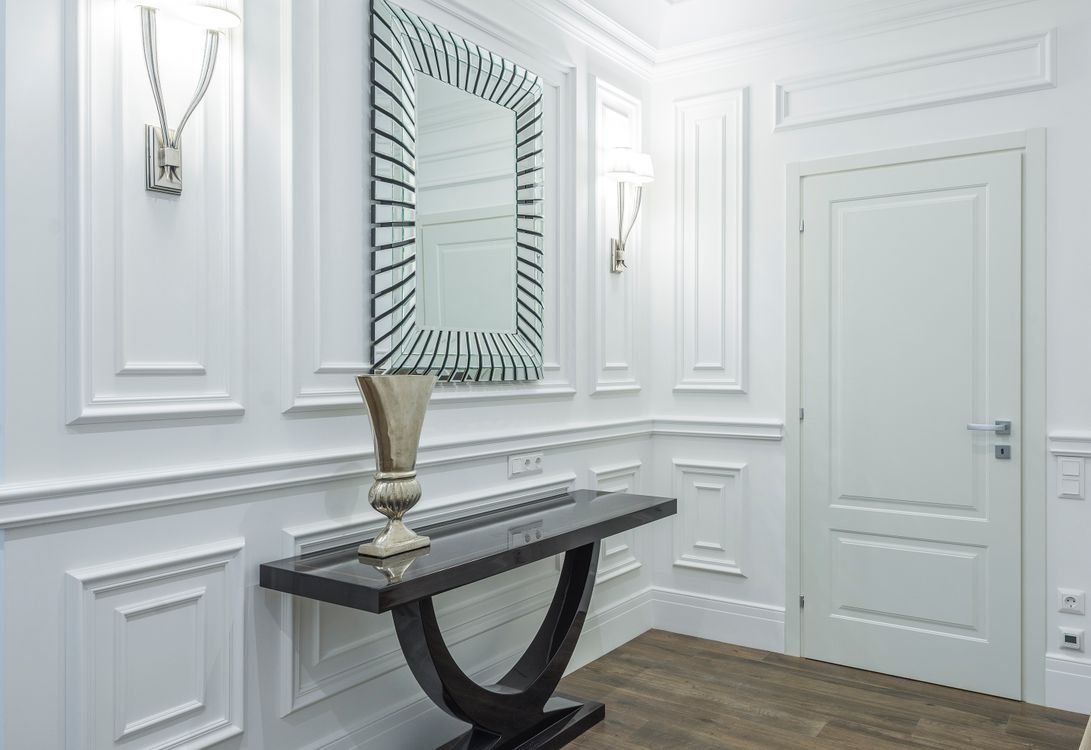
Height against what is already there. Behind a sofa, compare with the sofa back height as above. Under wall panelling or wainscoting, check the chair rail: rails usually sit 32 to 36 inches from the floor. A table just below the rail looks built-in; a table that ends an inch above the rail looks like a mistake, so measure and choose a side. If your entry walls have panel moulding, our guide to proportions and spacing is here.
Construction and wobble. A half-round top on three legs is only as good as its joints. Budget tables are often MDF with a printed or painted finish — fine for decor, not for a heavy stone lamp plus a stack of books. Solid wood, or veneer on a solid frame, carries weight better and survives hallway bumps. Plan on felt pads and, with kids or big dogs, the anti-tip strap: narrow, tall and light is exactly the profile that tips.
Small rooms beyond the entry. The same sizing logic works on any short wall — a demilune also makes a good dressing table in a small bedroom, where wall space is as tight as the layouts show.
Styling basics that actually work
Keep it to three layers. Something tall on the wall above — a mirror or a single piece of art, centred on the table, its bottom edge 6 to 8 inches above the tabletop. Something with height on the table itself, usually a lamp at one end or a vase; lamps also solve the dark-entryway problem. Then one low, practical layer: a tray or shallow bowl for keys, a short stack of books or a small box. Leave at least a third of the surface empty — styled edge to edge, a demilune looks smaller than it is and the curve disappears under clutter.
Behind a sofa, skip the mirror — the wall is not the backdrop there — and use a pair of lamps, or one lamp and a plant, so the arrangement reads from both sides.
What demilune tables cost
Prices below are typical US ranges, not quotes. Basic flat-pack and MDF tables run about $60 to $150. The crowded middle — solid wood or good veneer, standard 31-to-42-inch widths — is roughly $180 to $450, and this is where most people should shop: joints are better and finishes survive daily use. Marble tops, carved bases and designer names push $500 to $1,200 and beyond, which buys looks more than function. Secondhand demilunes are common and often solid wood; check for wobble and water rings before paying.
FAQ
Will a demilune fit in a 36-inch-wide hallway?
Yes, if you buy by depth, not width. A small table 12 to 14 inches deep leaves 22 to 24 inches of passing room at its widest point, and more at the curved ends. Tape the footprint down and walk it carrying a laundry basket; if that passes comfortably, the table works.
What is the difference between a demilune and a regular console table?
Shape and depth. A console table is rectangular and the same depth end to end. A demilune is a half-round: deepest in the centre, shallower at the ends, with a flat back for the wall. In open rooms they are interchangeable; in tight walkways the demilune is easier to pass.
How high should a demilune be behind a sofa?
Level with the top of the sofa back, or up to 2 inches below it. Measure your sofa back before ordering — most are 30 to 35 inches — and match the table to that number rather than buying the standard size and hoping.
Can a demilune hold a lamp and books safely?
A standard wood model handles a table lamp and a small stack of books without trouble. The risk is not the weight in the middle, it is tipping: tall, narrow tables in traffic paths should get felt pads under the feet and a furniture strap to the wall, especially with children around.
Does a demilune work in a rental where I can’t anchor it?
Usually, yes. Choose a heavier solid-wood or pedestal-base model, which resists tipping better than a light three-leg design, keep tall items off it, and place it where it will not be bumped daily — a hallway end rather than beside the front door.
The short version
A demilune earns its place when the wall is short, the walkway is tight, or a sofa back needs finishing. Buy it by three numbers — wall length minus vents and trim, the deepest footprint your walkway can spare, and a height matched to your sofa back or chair rail — tape the shape on the floor before you order, and the table will look like it was made for the spot.